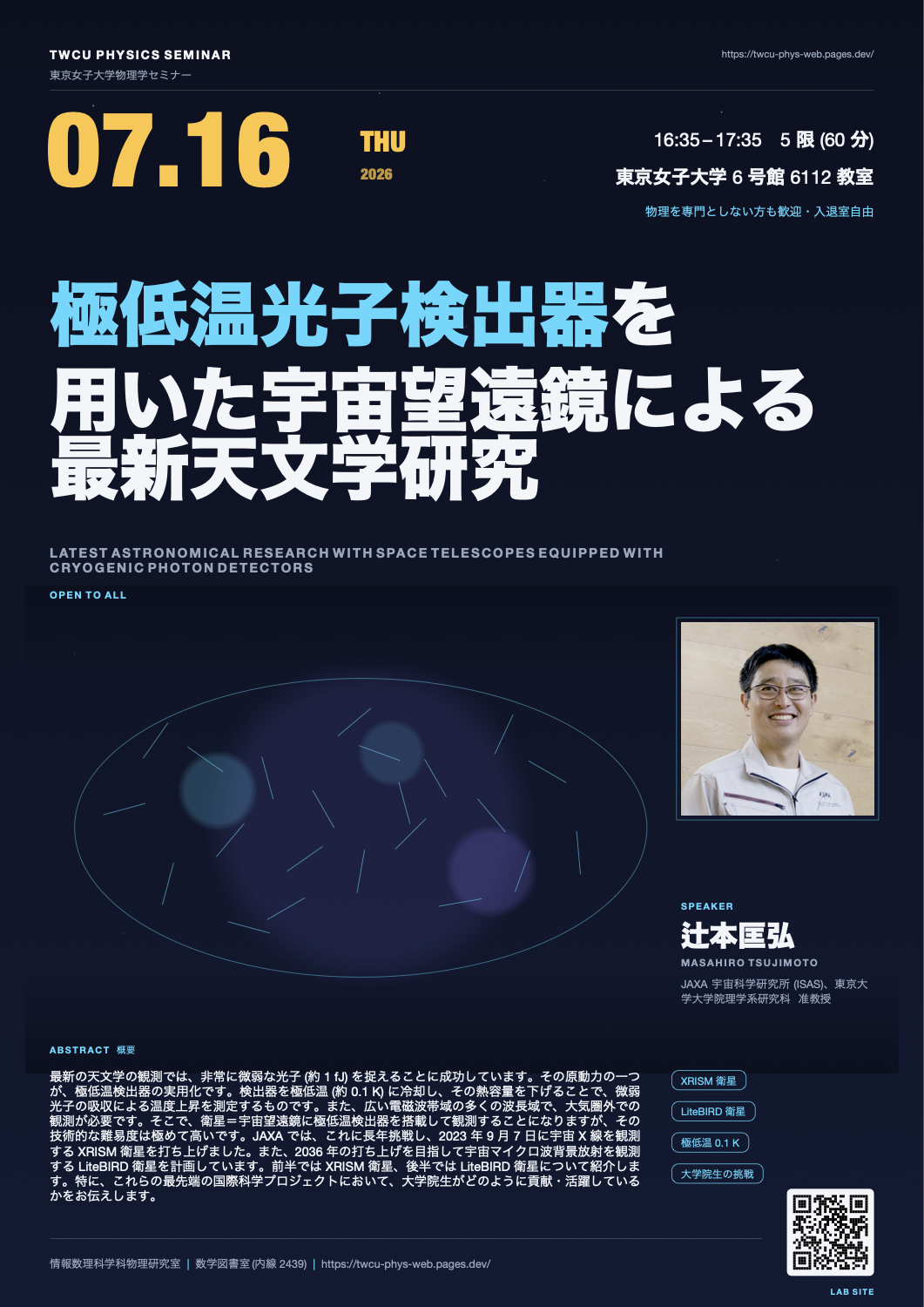
Latest Astronomical Research with Space Telescopes Equipped with Cryogenic Photon Detectors
Recent astronomical observations have succeeded in detecting extremely faint photons (about 1 fJ). One of the driving forces behind this is the practical deployment of cryogenic detectors, in which the detector is cooled to cryogenic temperatures (about 0.1 K) so that its lowered heat capacity allows the temperature rise from a faint photon absorption to be measured. In addition, observations at many wavelengths across a broad electromagnetic spectrum must be carried out above the atmosphere, and mounting cryogenic detectors on satellite telescopes to do so poses extremely high technical challenges.
JAXA has pursued these challenges for many years and launched the XRISM satellite, which observes cosmic X-rays, on September 7, 2023. JAXA is also planning the LiteBIRD satellite, which will observe the cosmic microwave background, targeting launch in 2036. The first half of the talk will introduce XRISM, and the second half will introduce LiteBIRD. In particular, we will describe how graduate students contribute and thrive in these cutting-edge international scientific projects.
Slides & materials