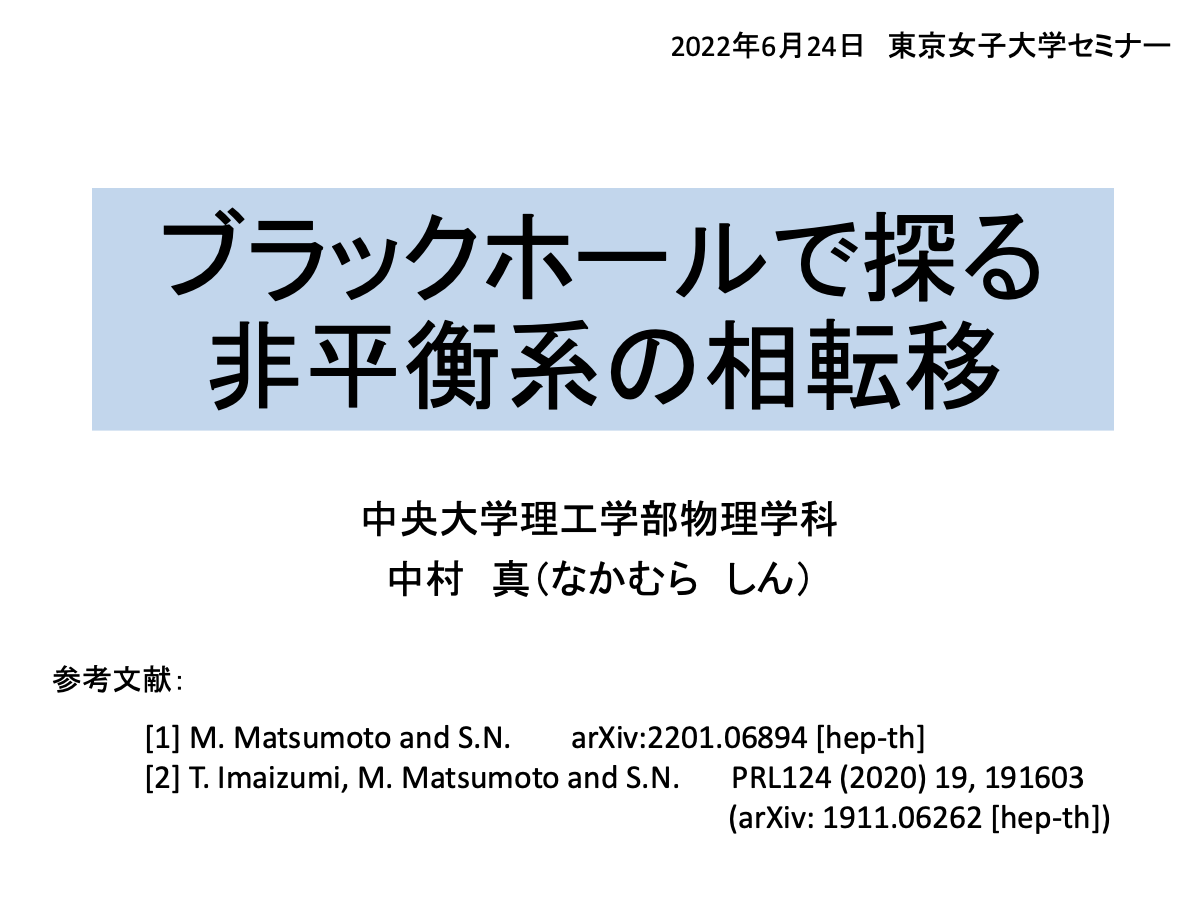
Phase Transitions in Non-Equilibrium Systems Probed by Black Holes
Phase transitions — phenomena in which the state of matter changes abruptly, like water turning into ice or steam — are typically analyzed by assuming thermal equilibrium ("no motion") both before and after. But what happens if we consider phase transitions in a state with "motion" — that is, out of equilibrium? For example, when water turns to ice in a non-uniform flow, does the freezing temperature differ from that of stationary water? To explore such questions, this seminar provides an introductory discussion of phase transitions in non-equilibrium steady states, using analytical techniques derived from the gauge/gravity correspondence — an application of black-hole physics.
Slides & materials